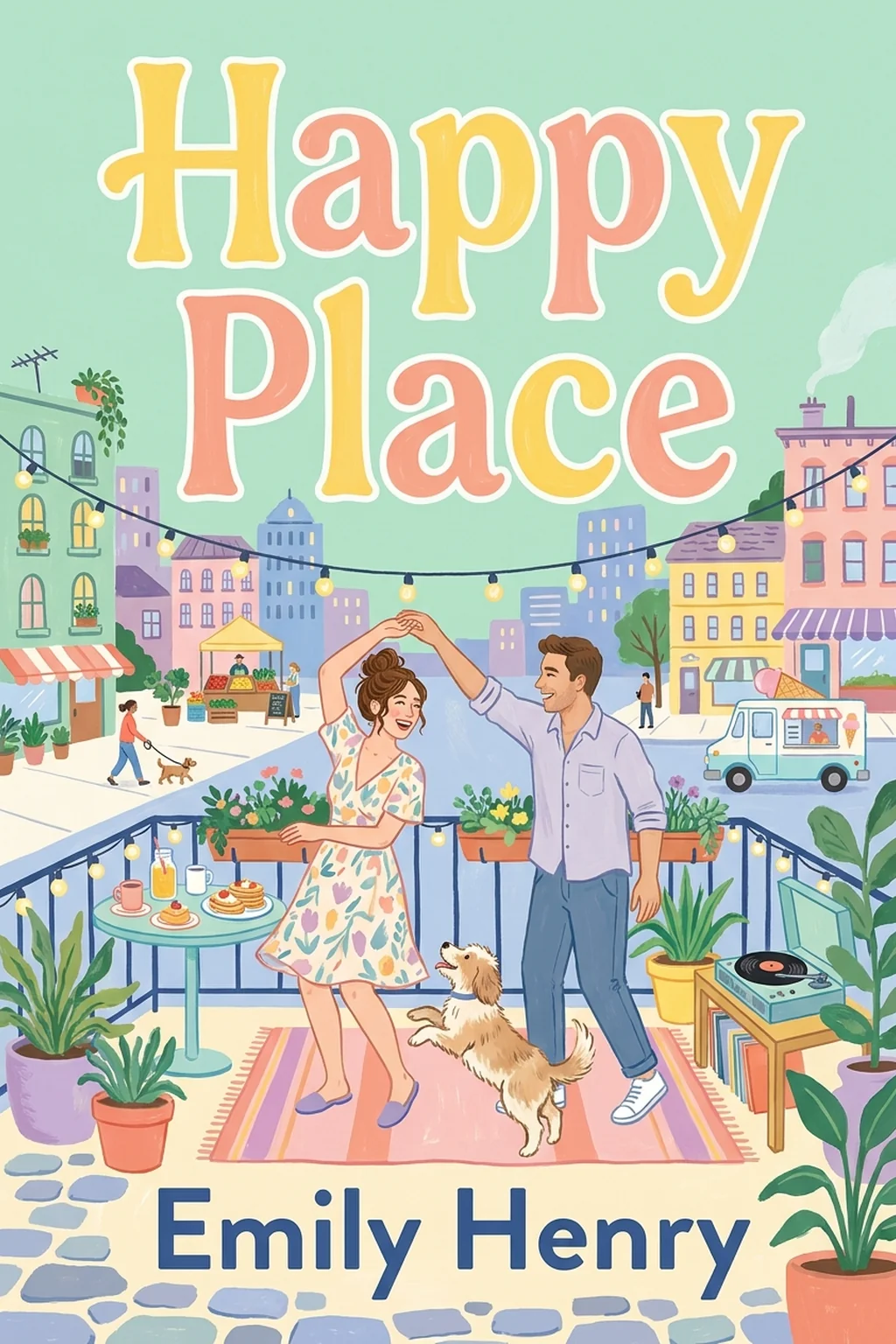
Happy Place
The best romantic comedies are comedies first, and Happy Place earns its ending on that basis. Read it as 42 chapters and 101,209 words, steady in rhythm and light in content, with Enemies to Lovers, Opposites Attract, Slow Burn doing the structural work.
Overview
The best romantic comedies are comedies first, and Happy Place earns its ending on that basis. Read it as 42 chapters and 101,209 words, steady in rhythm and light in content, with Enemies to Lovers, Opposites Attract, Slow Burn doing the structural work. Happy Place keeps the dialogue sharp enough to carry a whole book.
Happy Place keeps a clear line between what the characters say and what they mean, and the distance is where the tension sits.
There is a confidence in the writing of Happy Place — Emily Henry does not explain a feeling when showing it will do.
A Happy Place reader should expect to be moved more than surprised — Emily Henry favours emotional precision over plot fireworks.
At a glance
- Author
- Emily Henry
- Genre
- Romantic Comedy
- Series
- Standalone
- Publisher
- Penguin Publishing Group
- Published
- April 25, 2023
- Length
- 101,209 words
- Chapters
- 42
- Est. reading time
- 405 minutes
- Point of view
- Third person
- Pace
- Steady
- ISBN
- 9780593441275
Reading profile
What the shape of this book feels like before you start it.
Tone
Quick, funny and built on verbal sparring
Pace
Steady and well-paced, with room for both plot beats and character work.
Point of view
Third person
Length
101,209 words across 42 chapters, around 405 minutes at an average reading pace.
Counting 42 chapters and 101,209 words, Happy Place is built at a scale that suits the story it is telling: slow enough to develop the central pair, short enough to keep the pace visible.
Tropes and themes
The patterns this book draws on, and what each one does to the story.
Enemies to Lovers
The central tension is not attraction despite dislike but attraction because of it — two people who read each other accurately and cannot stop paying attention.
Opposites Attract
The book keeps returning to a small number of questions about honesty and self-image, and the romance is the place where those questions get answered.
Slow Burn
The attraction is acknowledged early and acted on late. The gap is spent on character development rather than on delay.
Chapter guide
The real table of contents for Happy Place, grouped into the four movements of the book.
Part One — The Opening
The first quarter of Happy Place is setup, and Emily Henry does it with intent. Rather than throwing the reader into the middle of a life, this stretch establishes what the two leads each want and how badly the current arrangement is working for them.
- Chapter 1The closing chapter, which leaves the reader where it should.764 words
- Chapter 2A quieter chapter, and one of the few places the book lets the setting speak.3k words
- Chapter 3Establishes what each character wants before they know they are in conflict.3k words
- Chapter 4The reconciliation is built here, out of what the book has already earned.3k words
- Chapter 5The midpoint of the central arc, where the stakes become explicit.3k words
- Chapter 6The pressure arrives here, and the tone darkens slightly.4k words
- Chapter 7Where the cost of what they want starts to become clear.5k words
- Chapter 8The first real friction, and the point where the premise starts to bite.1k words
- Chapter 9The closing stretch, in which the book pays off what it has been promising.3k words
- Chapter 10The tension between them reaches its most visible form.954 words
Part Two — The Rising Action
The second quarter is where the book starts to push. The obstacles that were background become active, and the leads have to respond to each other rather than simply exist in the same story. Expect the pace to pick up here.
- Chapter 11The midpoint of the central arc, where the stakes become explicit.5k words
- Chapter 12The tension between them reaches its most visible form.4k words
- Chapter 13Turns the plot toward the complication that carries the second half.2k words
- Chapter 14The final approach — everything narrows toward the ending.3k words
- Chapter 15Deepens the emotional stakes without adding new machinery.3k words
- Chapter 16Turns the plot toward the complication that carries the second half.1k words
- Chapter 17A quieter chapter, and one of the few places the book lets the setting speak.3k words
- Chapter 18Where the plot and the relationship accelerate together.3k words
- Chapter 19The closing stretch, in which the book pays off what it has been promising.5k words
- Chapter 20The closing stretch, in which the book pays off what it has been promising.2k words
Part Three — The Turn
Past the midpoint, Happy Place turns. Complications that were planted earlier arrive, and the tone darkens for a while before the book begins to gather its threads. This is where the book earns the ending it is going to deliver.
- Chapter 21Turns the plot toward the complication that carries the second half.2k words
- Chapter 22The middle stretch, and the part where the dynamic between them starts to shift.2k words
- Chapter 23A chapter that mostly exists to let a decision land.4k words
- Chapter 24The point of no return, and the chapter the rest of the book is built around.2k words
- Chapter 25A chapter that mostly exists to let a decision land.627 words
- Chapter 26The pressure arrives here, and the tone darkens slightly.656 words
- Chapter 27The final approach — everything narrows toward the ending.3k words
- Chapter 28Where the cost of what they want starts to become clear.2k words
- Chapter 29Turns the plot toward the complication that carries the second half.5k words
- Chapter 30The point of no return, and the chapter the rest of the book is built around.2k words
Part Four — The Resolution
The final stretch resolves what the middle raised. Emily Henry closes the outstanding threads rather than leaving them dangling, and the last chapters are quieter than the ones before them — which is usually a sign the work is done.
- Chapter 31A quieter chapter, and one of the few places the book lets the setting speak.2k words
- Chapter 32Where the cost of what they want starts to become clear.4k words
- Chapter 33The pressure arrives here, and the tone darkens slightly.2k words
- Chapter 34The closing chapter, which leaves the reader where it should.5k words
- Chapter 35The middle stretch, and the part where the dynamic between them starts to shift.3k words
- Chapter 36The complication lands, and the earlier threads begin to converge.1k words
- Chapter 37The reconciliation is built here, out of what the book has already earned.928 words
- Chapter 38Where the cost of what they want starts to become clear.1k words
- Chapter 39Where the plot and the relationship accelerate together.2k words
- Chapter 40A quieter chapter, and one of the few places the book lets the setting speak.2k words
- What’s next on your reading list?The threads start to gather, and the ending becomes visible.30 words
Content notes
Heat rating: light (1/5). See the site-wide content advisories for a full list of what to check before starting. <a href="/disclaimer/">Read the content notes</a>.
Who should read this
Readers who like a book with a shape
With 42 chapters and a clear structure, Happy Place is easy to pick up and put down without losing your place — which matters more than it sounds in a long read.
Readers who like slow builds
If you prefer a romance that takes its time establishing the people before it asks them to make a decision, Happy Place rewards patience. The first third is doing real work.
Readers who like banter
There is real dialogue in Happy Place — conversations that could be lifted out and read on their own. That will appeal if sharp talk is a non-negotiable for you.
Readers who want a clean emotional arc
If you prefer a romance that resolves its tensions rather than leaving them for a sequel, Happy Place closes its threads properly.
If this one appeals, try these
Similar genre, tropes and tone — from the LumiNridge catalogue.

Not in Love
Romantic Comedy · Steady · 99k words · Forbidden Love & Enemies to Lovers
The Boyfriend Candidate
Romantic Comedy · Propulsive · 102k words · Fake Dating & One Night Stand
The True Love Experiment
Romantic Comedy · Propulsive · 104k words · Enemies to Lovers & Opposites Attract
The Unhoneymooners
Romantic Comedy · Unhurried · 85k words · Enemies to Lovers & Opposites Attract

The Way I Hate Him
Contemporary Romance · Unhurried · 160k words · Enemies to Lovers & Workplace

Bad Girl Reputation
Contemporary Romance · Steady · 88k words · Second Chance & Workplace
Editorial verdict
Our recommendation on Happy Place is straightforward. If you want a steady Romantic Comedy read of about 101,209 words, this is the kind of book that rewards finishing.
About Emily Henry
Emily Henry appears once in the LumiNridge catalogue. The book stands on its own, and the author page collects the full shelf for reference.
Frequently asked questions
Is Happy Place a Romantic Comedy book?
Yes. It is catalogued as Romantic Comedy, and the tropes it leans on — Enemies to Lovers, Opposites Attract, Slow Burn — are all drawn from that shelf. If you have read widely in the genre and want an example that executes the conventions well, this is worth a look.
How long does Happy Place take to read?
It runs to roughly 101,209 words across 42 chapters — about 405 minutes at an average reading pace. That makes it a comfortable weekend read, or something you can work through in a week of short evening sessions.
What is the point of view in Happy Place?
It is told in Third person. The third-person narration lets the book step back far enough to show what the characters cannot see about themselves.
What tropes does Happy Place use?
The catalogue tags it with Enemies to Lovers, Opposites Attract, Slow Burn. Each of those shapes a different part of the plot, and the tropes section on this page explains what each one does to the story.
Does Happy Place have a series?
Not on its own. It stands alone, which means you can read it without tracking a series order, and nothing else in this catalogue depends on having read it first.